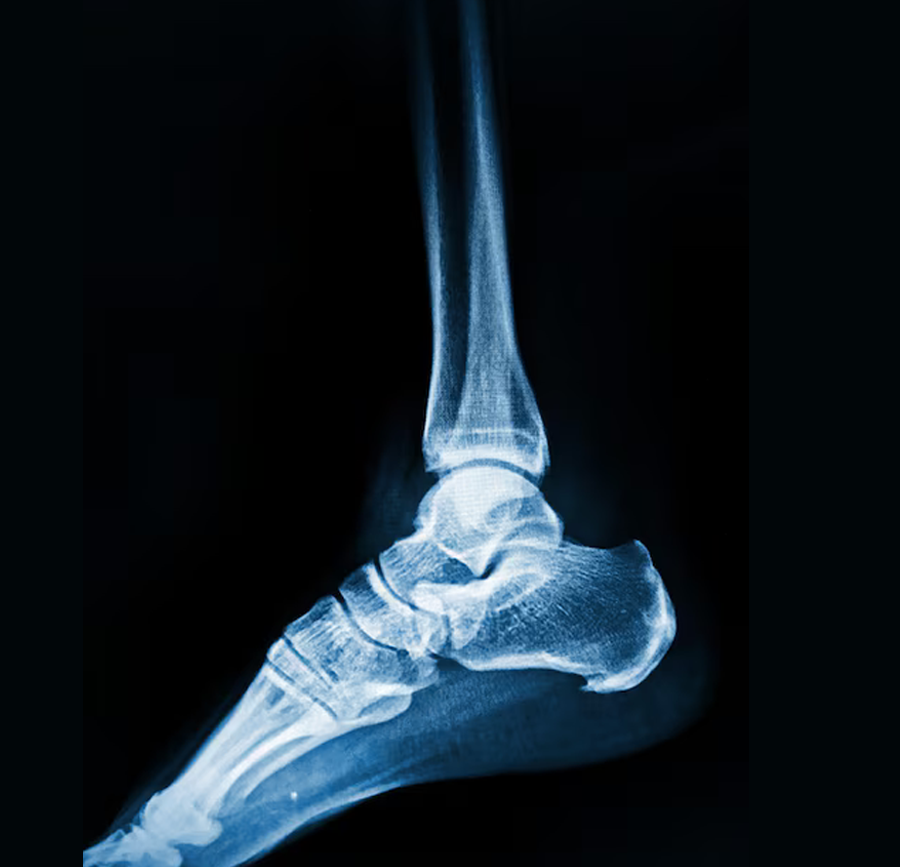
A calcaneal spur, or commonly known as a heel spur, occurs when a bony outgrowth forms on the heel bone. Calcaneal spurs can be located either at the back of the heel (dorsal heel spur) or under the sole (plantar heel spur). The dorsal spurs are often associated with achilles Tendinopathy, while spurs under the sole are associated with Plantar fasciitis.
The apex of the spur lies either within the origin of the planter fascia (on the medial tubercle of the calcaneus) or superior to it (in the origin of the flexor digitorum brevis muscle). The relationship between spur formation, the medial tubercle of the calcaneus and intrinsic heel musculature results in a constant pulling effect on the plantar fascia resulting in an inflammatory response.
The spur is thought to be a result of the biomechanical fault and an incidental finding when associated with a painful plantar heel. The most common etiology is thought to be abnormal pronation which results in increased tension forces within the structures that attach in the region of the calcaneal tuberosity.
CAUSES
- Heel spurs occur when calcium deposits build up on the underside of the heel bone, a process that usually occurs over a period of many months.
- Heel spurs are often caused by strains on foot muscles and ligaments, stretching of the plantar fascia, and repeated tearing of the membrane that covers the heel bone.
- Heel spurs are especially common among athletes whose activities include large amounts of running and jumping.
Risk factors for heel spurs include:
- Walking gait abnormalities, which place excessive stress on the heel bone, ligaments, and nerves near the heel
- Running or jogging, especially on hard surfaces
- Poorly fitted or badly worn shoes, especially those lacking appropriate arch support
- Excess weight and obesity
Other risk factors associated with plantar fasciitis include:
- Increasing age, which decreases plantar fascia flexibility and thins the heel’s protective fat pad
- Diabetes
- Spending most of the day on one’s feet
- Frequent short bursts of physical activity
- Having either flat feet or high arches
SYMPTOMS
- Sharp pain like a knife in the heel when standing up in the morning
- A dull ache in the heel throughout the rest of the day
- Inflammation and swelling at the front of the heel
- Heat radiating from the affected area
- Small, visible bone-like protrusion under the heel
- Point of tenderness at the bottom of the heel that makes it hard to walk barefoot
- If a person experiences these symptoms, a doctor may take an X-ray of their foot to determine the problem. Seeing the protrusion on an X-ray is the only way to be sure a person has heel spurs.
Not everyone with a heel spur will experience all of these symptoms. Some people with heel spurs may experience no symptoms at all. These people may only discover they have heel spurs if they have an X-ray for another reason.
DIAGNOSTIC PROCEDURES
A diagnosis is based on the patient’s history and on the results of the physical examination. Diagnosis is usually confirmed by X-ray, but other diagnostic adjuncts are also used. Radiology may show calcaneal spur formation or calcification at either the insertion of the Achilles tendon or the origin of the plantar fascia. Rarely is an MRI required.
TREATMENTS
Rest: Getting plenty of rest and taking pressure off the feet can help to reduce pain and swelling in the affected area.
Applying ice: This can help reduce pain and swelling.
Using custom-made orthotics (shoe inserts): These donut-shaped inserts go inside the shoe to take the pressure off the heel.
Wearing cushioned sports shoes: These may also help to relieve pressure and reduce pain.
Anti-inflammatory medication: This helps to reduce swelling. Homeopathic medicines help reduce the planter fasciitis and reducing inflammation and can be a great resort to relive the pain. With homeopathic medicines and auxiliary line of treatment, Calcaneal spur can be managed very well. There are specific medicines which are useful for this condition. Consult a skilled registered homoeopathic practitioner to get your right remedies.
DIETARY SUGGESTION
Increase Anti-Inflammatory Foods
Foods that are high in calcium, magnesium, MSM (found in many fresh fruits, vegetables, and grains), and vitamin C can greatly reduce the effects of Plantar Fasciitis.
Calcium helps by preventing the development of heel spurs (protrusions that can irritate the soft cushion of your heel), while MSM, magnesium, and vitamin C reduce inflammation.
Anti-inflammatory foods
- Spinach – High in vitamin C, calcium, magnesium, and MSM.
- Oranges – High in calcium, MSM, and vitamin C.
- Pumpkin seeds – High in calcium and vitamin C
- White beans – High in calcium and magnesium
Decrease Inflammatory Foods
- Sugar – increases irritation and inflammation in body tissues.
- Processed grains – Refined grains (for example, bleached white flour) can also increase inflammation.
- Saturated fat and Trans fats – processed junk food and treats, as well as processed meats like hot dogs and pepperoni increases inflammation.
FEW HOMEOPATHIC MEDICINES
Ammonium Muriaticum
When there is Pain in Heel on Walking
Aranea Diadema
For boring pain in Heel
Aurum Metallicum
For Calcaneal Spur which causes Pain at Night
Calcarea Fluorica
For pain in heel due to Calcaneal Spur
Daphne Mezereum
For Calcaneal Spur that hurts by touching
Rhus Tox
For pain on Standing
Ruta Graveolens
For pain in Heel extending to Achilles tendon