Kindly choose a date and time to schedule your appointment.
Register as a member and enjoy exclusive benefits on your second appointment. Your health journey just got more rewarding!
Carbuncle
Definition:
Carbuncle is an ineffective gangrene of the subcutaneous tissue due to Staphylococcal infection. Gram-negative bacilli and Streptococci may be found coincidentally.
Sites:
Carbuncles mostly seen on the back, in the nape of the neck where the skin is coarse and vitality of the tissue is less. The shoulders, the cheek, dorsum of the hand are the other rare sites. Hirsute portions of the chest and abdomen may also be involved.
Pathology:
When the invading staphylococci bacteria penetrate the deeper layers of the skin and the subcutaneous fat, a carbuncle is formed.This consists of a series of communicating abscesses, which discharge by separate openings on the surface. That is why the surface is sieve-like. Individual compartments in the carbuncle are maintained through persistence of fascial attachment to the skin. Carbuncles may be more extensive than they appear. There is a central large slough, surrounded by a rosette of small areas of necrosis. In untreated cases infection may extend widely with fresh openings appear on the surface, which coalesce with those previously formed. Under treatment when the central slough is drained off, fibroblastic reactions start from the surrounding granulation tissue and carbuncle heals with a characteristic induration.
Clinical Features:
It generally affects males above 40 years of age.
Often the subject is diabetic.
It commences as painful and stiff swelling which spreads very rapidly with marked indurations.
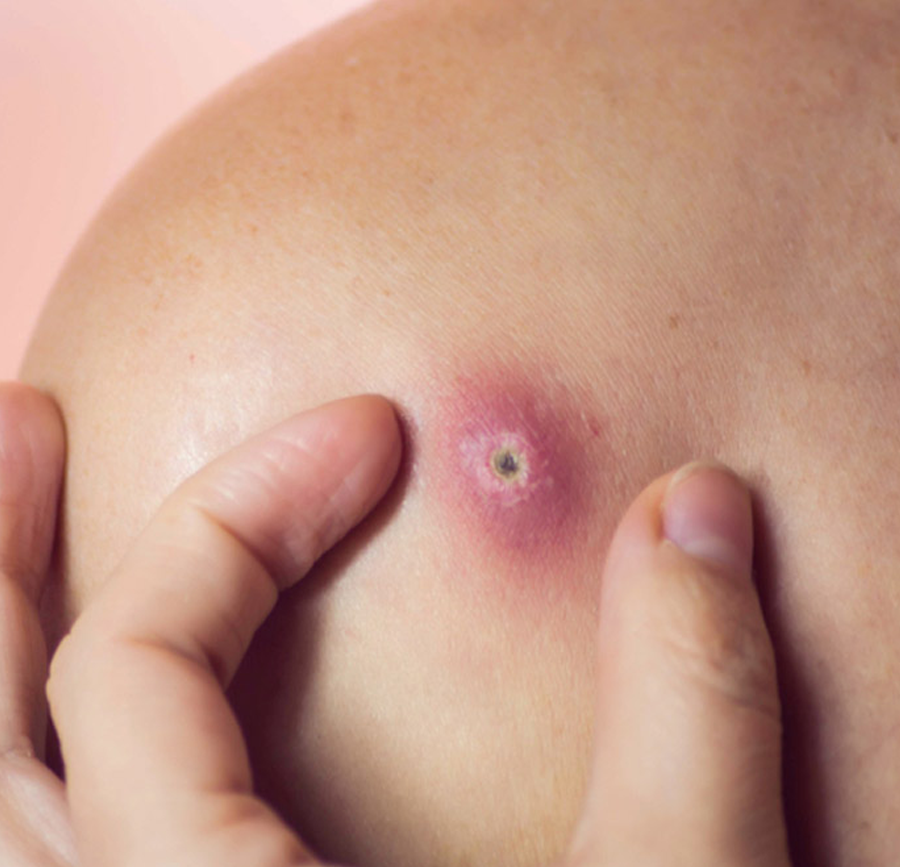
The overlying skin becomes red, dusky and oedematous.
Subsequently the central part softens and multiple vesicles appear on the skin.
Later on these vesicles transform into pustules.
These pustules subsequently burst allowing the discharge to come out through several openings in the skin producing a sieve-like or cribriform appearance, which is pathognomonic of carbuncle. These openings enlarge and ultimately coalesce to produce an ulcer.
At the floor of the ulcer lies the ashy-grey slough.
Finally the slough separates leaving an excavated granulation tissue, which heals by itself. When the resistance of the individual is poor in in diabetic subject, the sloughing process may extend deeply into the muscle or even bone.
Constitutional symptoms and toxaemia vary according to the degree of the resistance of the individual and efficacy of the treatment.
Treatment:
Improvement of the general health of the patient should be brought about
Conventional treatment includes oral antibiotic should be started immediately from the culture and sensitivity test.
Local application consists of – a paste composed of anhydrous magnesium sulphate and glycerine may be applied . This helps in a valuable osmotic affect and will not only reduce oedema but also will help to burst the carbuncle. Hot compress is helpful before bursting. It is sometimes supplemented by infra-red or short wave diathermy.
Surgery may be required – when toxaemia and pain persist even after a course of antibiotics as per conventional therapy.
When the carbuncle is more than 2 ½ inches in diameter. It must be remembered that incision is never made unless there is softening in the centre.
Homeopathic treatment: there are medicines in homeopathy which can be given to heal and absorb the carbuncle and results are very promising. But medicines should be taken in consultation with a registered homeopathic practitioner. Few medicines which are known to be very effective for carbuncle and their indications are detailed below for reference. Kindly use this information in consultation with a registered homeopathic practitioner.
Carbuncle medicines:
Arsenic album: This is generally regarded as the chief remedy in carbuncle. The great indication is burning as if coals of fire were on the affected part. There are also cutting, lancinating pains with aggravation after midnight, and great irritability of mind and body. Warm applications relieve the Arsenic pains.
Belladonna: Bright redness; throbbing pains; erysipelatous inflammation around carbuncle; cerebral irritation. Boils with much swelling and redness Belladonna is the remedy to be used in the early stages. Boils recurring in the spring also indicate the remedy.
Calcarea sulphurica is also a remedy to remove the tumefaction of boils.
Nitricum acidum: Putrid decomposition with tendency to haemorrhages; excessive debility with copious night-sweats.
Hepar sulphur: Carbuncle surrounded by indurated spots; pain intense, sleeplessness; stinging burning of edges of ulcer with corroding discharge.
Rhus toxicodendron: Burning, itching around carbuncle, with vertigo, stupor, pale face; great restlessness; feels somewhat relieved of violent pain as long as he is in motion; more indicated in the beginning, when the pains are intense and the affected parts are dark red. Orbital cellulitis.
Secale cornutum: Cannot bear external warmth.
Sulphur: This remedy produces a tendency to boils and is applicable to scrofulous persons.
Crotalus horr: Boils, carbuncles, and eruptions are surrounded by purplish, mottled skin and oedema. Sore sensation relieved by pressure.
Apis: Carbuncles, with burning, stinging pain. Sudden puffing up of whole body.
Gun Powder: The great sphere of action of gunpowder is in cases of septic suppuration-or, in other words-of wounds that have become poisoned with the germs of putrefaction. In the case of boils, carbuncles, and other skin affections, including eczema, abscesses, whether septic or not, blood-poisoning form bites of insects, ptomaine poisoning form food that has been improperly preserved.
Anthracinum: It will often promptly relieve the burning, agonizing pains of carbuncle.
Echinacea purpurea: Good remedy in carbuncle, the septic state, the prostration and the pain are well met by it, and it may also be applied externally.
Lachesis mutus: Lachesis is a very useful remedy when the surface is swollen and pus forms very slowly. The parts are purplish-looking with evidences of blood poisoning; there is great burning, relieved by washing in cold water. Small boils surrounding the main sore is a valuable indication. Carbuncles which slough and are very offensive call for Lachesis.
Tarentula cubensis: Tarantula Cubensis produces a perfect picture of sloughing carbuncle with great prostration, and it relieves the atrocious pains accompanying it. An indication is an early marked black core centre. Hughes has repeatedly verified this remedy in carbuncle.
Silicea terra: This remedy comes in to favor healthy suppuration and promote healthy granulations. Carbuncles on back between the shoulders.
References
S.Das, A concise Textbook of Surgery, 1996
Davidson’s: Principles and Practice of Medicine, 1995
Homeopathic therapeutics –the classical therapeutic hints, Samuel Hahnemann, 21 st impression, 2013